I tracked myself for 100 days to find out when I am most productive
A freelancer’s self-tracking experiment: sleep, steps, coffee, alcohol and Pomodoros, run through statistics software. With otters.
For about 100 days as a freelancer, I logged my sleep, steps, workouts, coffee, water, alcohol, Pomodoros and RescueTime productivity score, then looked for correlations in SPSS. My productive days came with many Pomodoros, more water and more coffee. Alcohol made the next day worse. Monday was my most productive day, Thursday my laziest.
One of the biggest draws of freelance life is that you no longer have to get up at the crack of dawn every day, listen to the latest ideas of a team lead who contains only traces of competence, and that you are, finally, your own boss. All of this can sound thrilling to people sitting in the glass cage of a sterile corporate office. It is not that simple.
Few people think about the fact that a digital nomad has no HR person and no legal department, and you deal with the clients on your own. In the same way, there is no boss who pushes you and tells you honestly that now you really have to start working, or this project will never get kicked through the heavenly gates of completion.
It is a bit like being a kid. We want to be “grown-ups” so that nobody can tell us how much chocolate we can eat before dinner. Then we grow up, and the real joy is comparing the sugar content of yoghurts in the supermarket aisles. Or maybe that is just me.
So self-discipline and routine are every freelancer’s greatest treasure and resource. However distant or hard to grasp these skills seem (after all, we have long “known” that girls are tidy and boys are lazy), the good news is that they can be measured, shaped and, above all, learned.
That thought drove me when I started this experiment back in September. Instead of outside feedback, the grumpy after-school teacher walking around with a stick, I decided it might be better to turn to science!
Even I think this article is fairly dry and grey, so here are some cute otters. Maybe they help!

Method
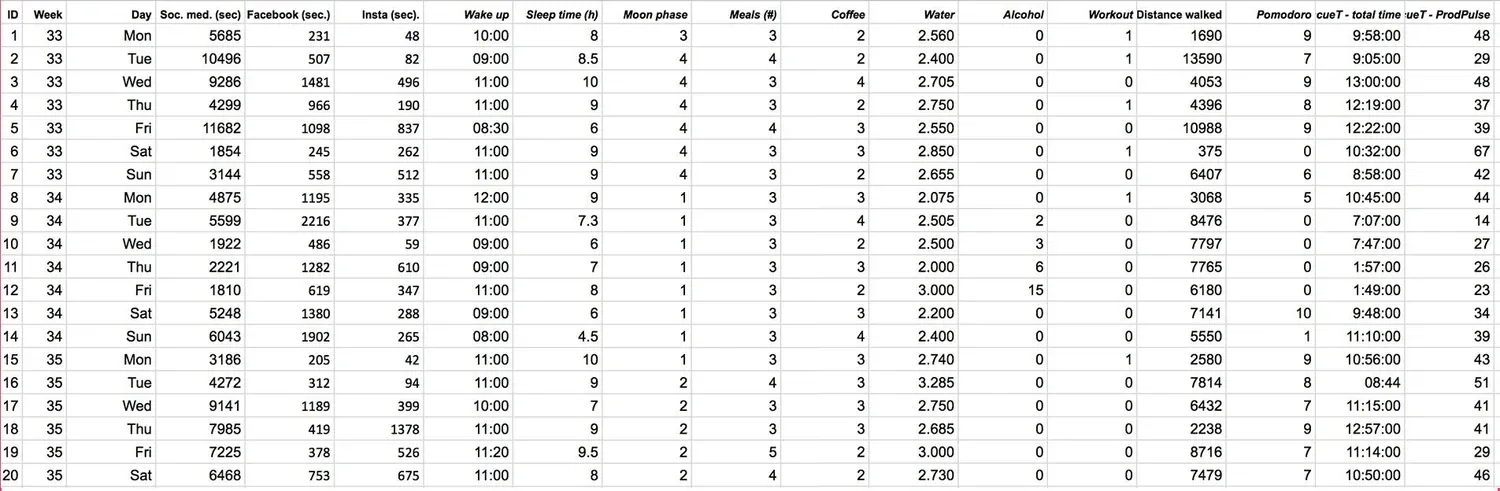
I collected data along three main dimensions in a beautiful Google Sheet: physiological variables, my consumption habits, and the productivity numbers of the day.
Physiological variables included when I got up, how much I slept, whether I worked out, and how far I walked that day. And to win over the more esoteric readers, I also logged the phase of the moon. My phone’s step counter tracked the walking. I typed in the rest by hand every day.
Consumption habits covered how many meals I had that day, how much water I drank, how much alcohol I poisoned myself with, and how many coffees I had. I logged water with a handy little app (Hydro Coach). I logged alcohol from my best-intentioned memories, and for units I followed the guidelines of the UK’s National Health Service: a pint of beer is 2 units, a glass of wine is 2 units, a 2 cl shot of spirits is 1 unit.
Productivity numbers need a bit more explaining. On one side I counted how many Pomodoros I did that day. On the other, a small program called RescueTime helped.
The Pomodoro Technique is a time management method. Put very simply: you work on one task for a 25-minute block, then rest for 5 minutes. I try to translate all my work into this system, so it made sense to include it as a variable. The 25 minutes of work happen in hard focus, with no distractions, so after four Pomodoros I usually need to rest for at least an hour.
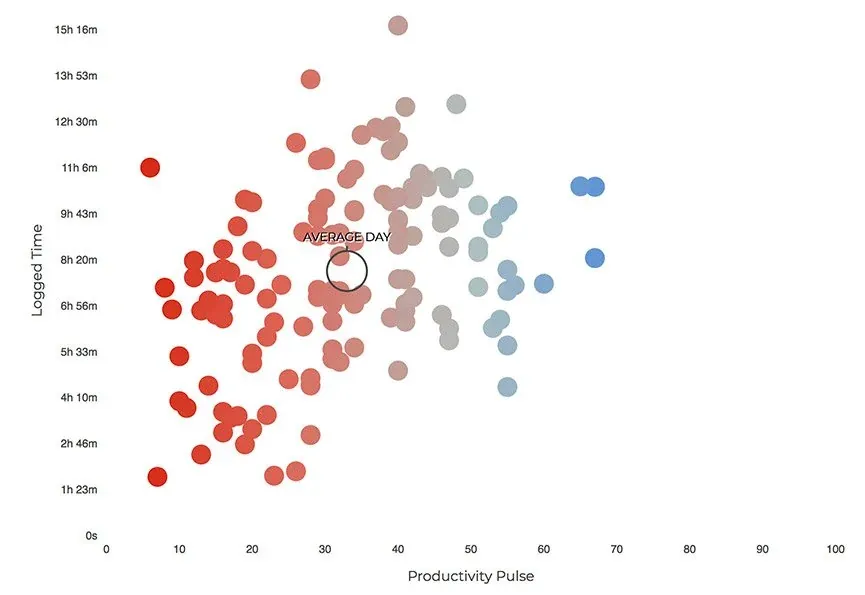
RescueTime is a desktop and mobile app that watches and logs how much time you spend on each website, program or app. Beyond tracking time, it sorts every activity onto a five-step scale from very distracting to very productive. Scrolling Facebook or reading the news is very distracting, for example, while typing in a Word document counts as very productive. From this, RescueTime gives every day (or even every hour) a score from 1 to 100 called the Productivity Pulse. The higher the pulse, the more productive the day.
The end result looks something like this.
The whole thing is only roughly scientific, because plenty of distorting factors come in. To name a few:
- I entered many of the variables myself, and however hard I tried to remember correctly, there are surely mistakes.
- A final sample of 105 days is fairly decent, but a bigger one would be more reassuring. Especially since it included a holiday, which may have skewed things further.
- I usually drink a long coffee or an americano, but now and then a cappuccino, an espresso or a latte slips in, not to mention black or green tea. They all have different amounts of caffeine, but I counted each one as one coffee.
- I also squeezed every type of workout into one category, although yoga and running are completely different in movement and in their effect on the body.
- I counted as a meal any time I ate more than a banana or a granola bar. That is not quite fair either: a cup of instant soup or a fruit salad counts as much as the three-course family calorie massacre on a Sunday.
- My final productivity score is skewed further down because almost everything I do to relax happens on my laptop. I listen to music here, watch Netflix here, read the news and watch my favourite YouTube channels here. I have no separate music player, smart TV or magazine subscription. On one hand, that made my whole life very measurable. On the other, it led to some depressing productivity numbers.
Of course, the goal was not to draw a full caffeine map or keep a calorie diary. I was curious about proportions and connections. When the data collection ended, I cleaned up the sheet and loaded it into IBM’s statistics software, SPSS (paid, but there is a trial). There, with various exciting number magic, I looked at which variables were connected, meaning correlated, whether significantly or strongly significantly.
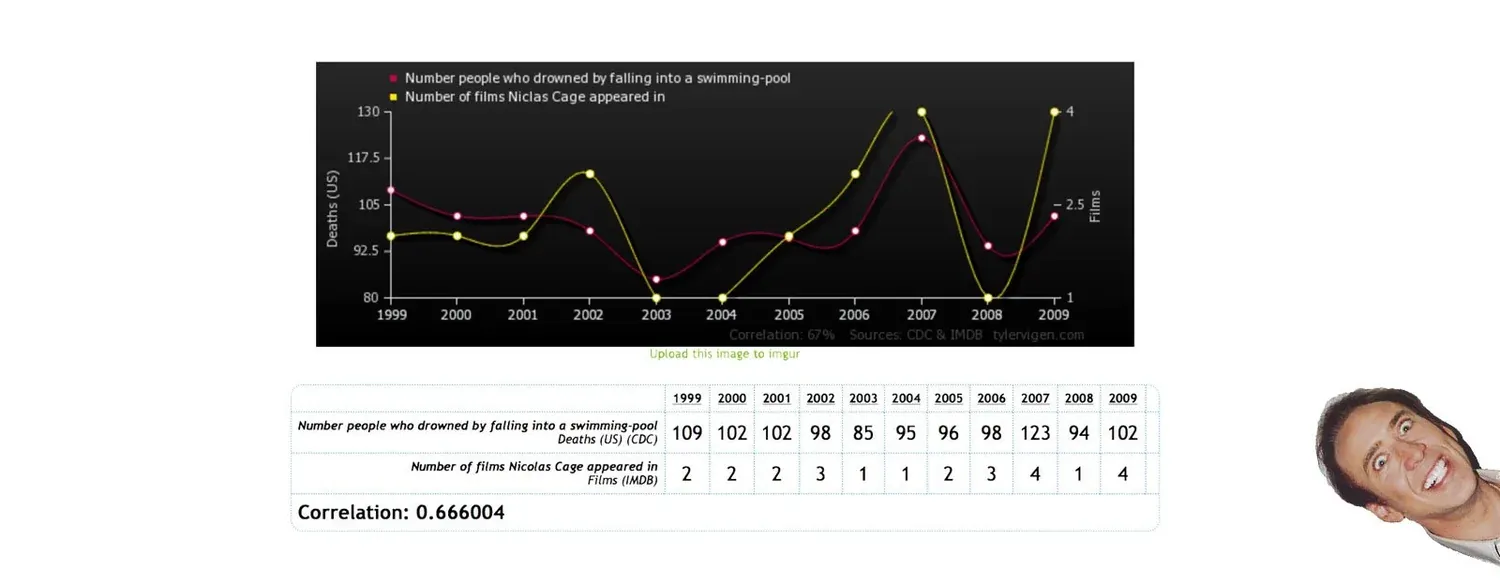
This is the point for the mandatory disclaimer: a connection between two variables does not mean that one causes the other.
So even if there is a strongly significant correlation between the number of people who drowned in a swimming pool in a given year and the number of Nicolas Cage films released that year, one does not follow from the other. At least not according to current science. Then again, maybe Nick Cage is a shapeshifter who secretly pushes people into pools. Not a bad hypothesis.

Results
I will not drag this out. Here is what came out, starting with the things where I measured a significant or strongly significant connection.
Body
- On days when I walk a lot, I get up earlier and sleep less.
- Speaking of walking: the more steps the counter logged on a day, the less I stared at a screen. Logical, since a longer, five-kilometre walk takes time.
- The later I get up, the more I slept (no way). My life has no real system here. It slides all over the place.
- Interesting: the later I get up, the more time I spend in front of screens that day.
- Let’s talk about workouts. On training days I drink a lot more water, and the next day I usually get up later. Also interesting: my urge to train lines up with the phases of the moon. I go to work out much more often at full moon and waning moon than at new moon and waxing moon.
Consumption
- On my productive days I drink a lot of water and a lot of coffee. Beyond the good effects of caffeine and H2O, this may also be because I like hanging out in cafés on workdays. Interesting: my water and coffee intake are not connected on their own, although caffeine is supposed to dehydrate you. It would be worth checking whether I also drink a lot of coffee on days I work from home, and whether I am just as productive then.
- As expected, alcohol hurts my productivity, and even a few units make the next day worse.
- What did surprise me is the strong connection between how much time I spend at the computer and how much I drink. Then again, it is logical: if you are drinking with your buddies, you are probably not working. For most of us, anyway.
- Science has shown that alcohol also lowers the quality of our sleep. I could not really measure that, but you can see that on nights out I sleep a lot less.
Productivity
- There was a very strong connection between my productivity (the Productivity Pulse) and my Pomodoro count. In plain words: on days when I did many Pomodoros, I was productive too. The time management system I work in clearly shows.
- It may sound like a contradiction, but on my busy days I spent a lot of time on social media. This is probably because I often use Facebook for work conversations. Which, by the way, is a terrible habit of mine.
- There is a strong connection between the phases of the moon and my social media use. Don’t ask me why.
- When I sleep little, I use Instagram more. Maybe when I am tired I care more about how perfect other people’s lives look, and it brings me down more easily!
- What reassured me: my social media use probably does not cost me productivity. There was no connection here. The less reassuring thought in exchange is that there was not a single day in the experiment when I did not check Facebook for at least a few minutes. We have all sold our souls.
Records
- I never drink more than four coffees, but I always need at least one.
- My longest workday was 12 hours.
- Daily social media use ranged from 490 to 14,286 seconds, so from 8 minutes to almost 4 hours. The latter was probably a harder workday, no need to panic, the author reassured himself.
- Walking record: 23,000 steps, on an easy hiking day.
- My most productive day is usually Monday, and my laziest, interestingly, is Thursday. Perhaps unsurprisingly, alcohol shows up most often on Fridays, and I walk the most on Sundays!
- Training days are usually Tuesdays and Thursdays. My most caffeinated day is Friday.
Averages
- On an average day I sleep 8.2 hours and have 2.3 coffees with 2.7 litres of water, and 0.74 units of alcohol still slips down. I work out about every second or third day, and my 3.2 daily meals come with 7,500 steps on average, about 5.7 kilometres.
- On an average workday I work 7 hours. That looks quite comfortable from the outside, but it leaves out lots of other projects, like this blog.
If I could repeat the test, I would add how happy I felt that day, and how satisfied I was with my work at the end of it. It may be hard to turn that into numbers, but I feel it matters. You can pile up data until the end of time, yet the self, as a person, shows more clearly in personal lessons like these. And who knows, maybe it would confirm what academics have long felt on their own skin: that alcoholism does lead to short-term happiness.
Lessons for the new year
One of the inspirations behind the whole experiment was Gábor Papp’s post from last year (which he has since repeated for the new year), a great little collection of thoughts on yearly goals, planning and self-assessment. Anyone a bit familiar with productivity knows that the biggest weapon against the thousand-headed dragon of procrastination is talking to yourself across time.
Gábor’s posts are about that too: the ability of your present self to regularly review your past actions and goals, see how many of those goals came true, and then set new ones for your future self. Sounds simple, right?
In practice it is damn hard to think through, every day, month or year, regularly and without fooling yourself, what we did well and what we could do even better.
This is the reckoning of my whole year of productivity. RescueTime ran from August, and you can see where most of my time went.
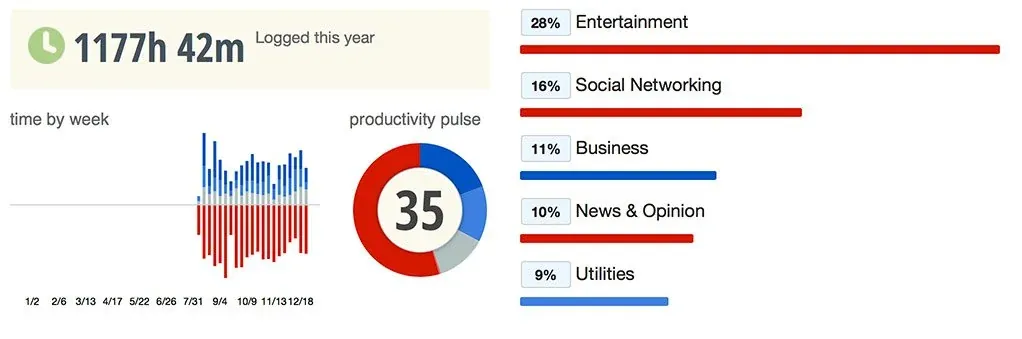
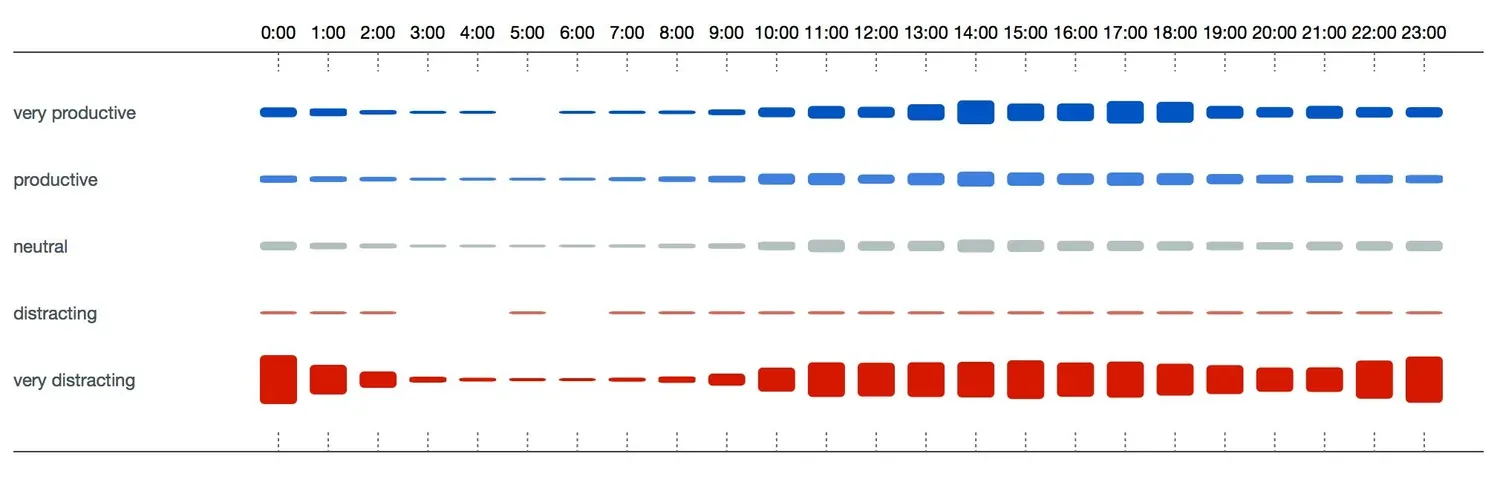
Based on this, I set a goal for 2018 right away: spend less time on less productive, clearly addictive activities built on instant feedback and reward, like reading the news or social media. A lot of my precious time bleeds out there. Of course, you can argue that everyone needs to relax and have hobbies. But the real question is: does Instagram actually help you switch off? Does index.hu, the Hungarian news site, really give you that much interesting information? And is Reddit really that useful for work?
I once read somewhere that success in life is not only measured by how much money we have, what community we live in, or how well known we are.
Success can also be measured by how much of our own time we are in charge of.
Is it a boss, a teacher, or maybe various time-stealing addictions that decide how you spend your time? As a freelancer, in some ways I have already beaten the first two. Maybe it is time to deal more with the third!
Happy New Year!
This piece first ran in Hungarian on bocsimiawifi.hu in January 2018.
Questions people ask
What did you track in the 100-day experiment?
Three groups of data, every day for 105 days: my body (wake-up time, sleep, workouts, steps, even the moon phase), what I consumed (meals, water, coffee, alcohol units) and how productive I was (Pomodoros done and the RescueTime Productivity Pulse score).
What made the biggest difference to your productivity?
The number of Pomodoros. Days with many 25-minute focus blocks had a much higher Productivity Pulse. My productive days also came with more water and more coffee, and alcohol made the next day worse.
Did social media make you less productive?
In my data, no connection showed up between social media time and productivity, partly because I also used Facebook for work conversations. Still, there was not one day when I did not check Facebook.
Does a correlation in self-tracking data prove cause and effect?
No. Two things can move together without one causing the other, like swimming pool drownings and the number of Nicolas Cage films released in a year.